

Capability Analysis with SigmaXL
This page demonstrates how process capability analysis is performed in SigmaXL. For a broad overview of capability concepts and indexes, see process capability in Six Sigma.
Understanding Process Capability with SigmaXL
Process capability in SigmaXL measures how well a process meets the specified outcome. It indicates whether a process conforms to specified requirements or specifications. Capability analysis helps improve process performance in meeting customer specifications and identify opportunities for process improvement.
Process Capability Analysis Steps
- Determine the metric or parameter to measure and analyze.
- Collect the historical data for the parameter of interest.
- Prove the process is statistically stable (i.e., in control).
- Calculate the process capability indices.
Monitor the process and ensure it remains in control over time. Update the process capability indices if needed.
Process Capability Indices
Process capability can be presented using various indices, depending on the process type and the analysis objective. Popular process capability indices are:
- Cp
- Pp
- Cpk
- Ppk
- Cpm
The Cp index is process capability. It assumes the process mean is centered between the specification limits and essentially is the ratio of the distance between the specification limits to six process standard deviations. Obviously, the higher this value, the better, because it means you can accommodate process variation within the spec limits more easily. Cp measures the process’s potential capability to meet the two-sided specifications. It does not account for the process average.
High Cp indicates a narrow process spread relative to the spread of the customer specifications. Cp is recommended when the process is centered between the specification limits. Cp is valid when both upper and lower specification limits are present. The higher Cp, the better, meaning the process spread is smaller relative to the specification spread.
Note: Cpm only works if a target value is specified.
Perform Process Capability with SigmaXL
Data File: Capability Analysis” tab in “Sample Data.xlsx
Steps in SigmaXL to run a process capability analysis:
- Select the entire range of data (i.e., the column “HtBk”)
- Click SigmaXL -> Process Capability -> Histograms & Process Capability
- A new window named “Histogram & Process Cap” pops up with the selected range of data appearing in the box under “Please select your data”
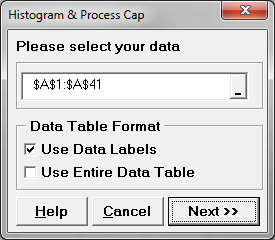
- Click “Next>.”
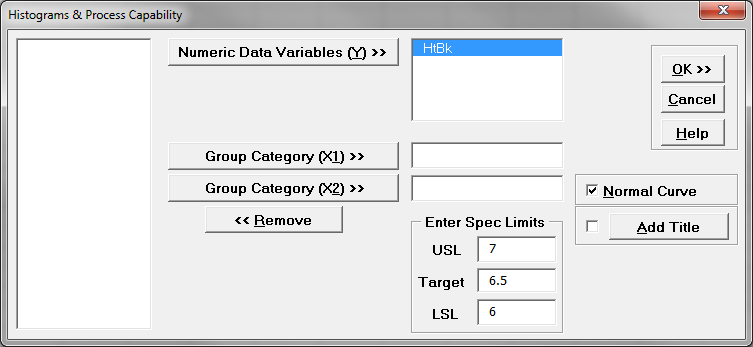
- A new window named “Histograms & Process Capability” appears
- Select “HtBk” as the “Numeric Data Variables”
- Enter 6 in LSL, 6.5 in T, and 7 in USL into the boxes for “Lower Spec Limit”, “Target”, and “Upper Spec Limit” respectively
- Click “OK”
- The histogram and the process capability analysis results are in the newly generated tab “Hist Cap (1)”
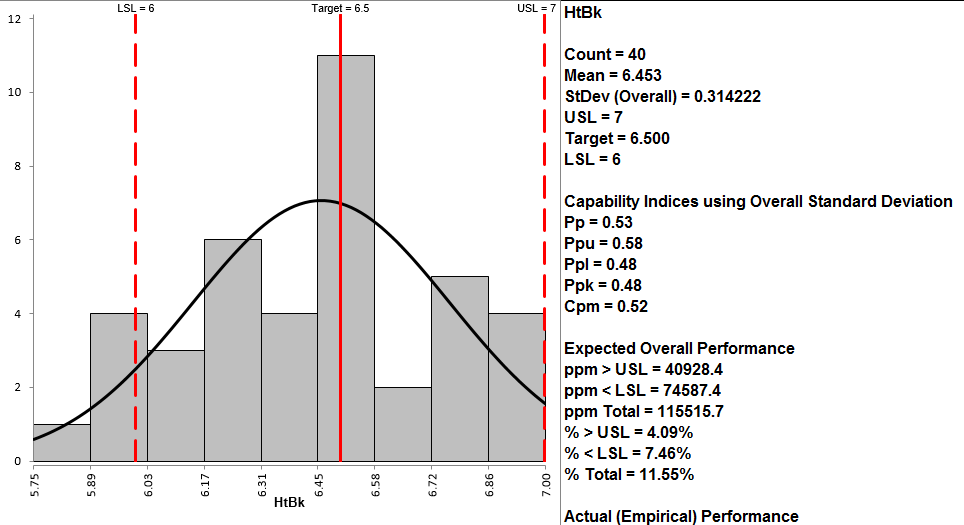
Model summary: With a Ppk of less than 1.0, we can conclude that the capability of this process is not very good. Anything below 1.0 should be considered not capable, and we should strive for Ppk to exceed 1, preferably over 1.67.
About Lean Sigma Corporation
Lean Sigma Corporation is an independent Six Sigma certification authority responsible for the development, administration, and governance of professional Six Sigma credentials. The organization defines certification frameworks, examination standards, and credentialing systems to evaluate and recognize Six Sigma competence across professional training environments.
Organizations and instructors delivering Six Sigma training in accordance with these recognized standards participate in Lean Sigma Corporation's Authorized Training Partner (ATP) Program.