

Six Sigma Hypothesis Testing Roadmap
Hypothesis testing is a core analytical method used in Six Sigma to validate assumptions, compare performance, and support data-driven decision-making. Within professional Six Sigma practice, hypothesis tests are applied systematically to confirm root causes, evaluate improvements, and assess process changes using statistical evidence rather than opinion.
What the Hypothesis Testing Roadmap Represents
The Six Sigma Hypothesis Testing Roadmap outlines how statistical tests are selected and applied within structured DMAIC projects—not as isolated calculations, but as part of disciplined analytical reasoning.
The roadmap reflects how hypothesis testing is taught, practiced, and evaluated in certification-aligned Six Sigma environments.
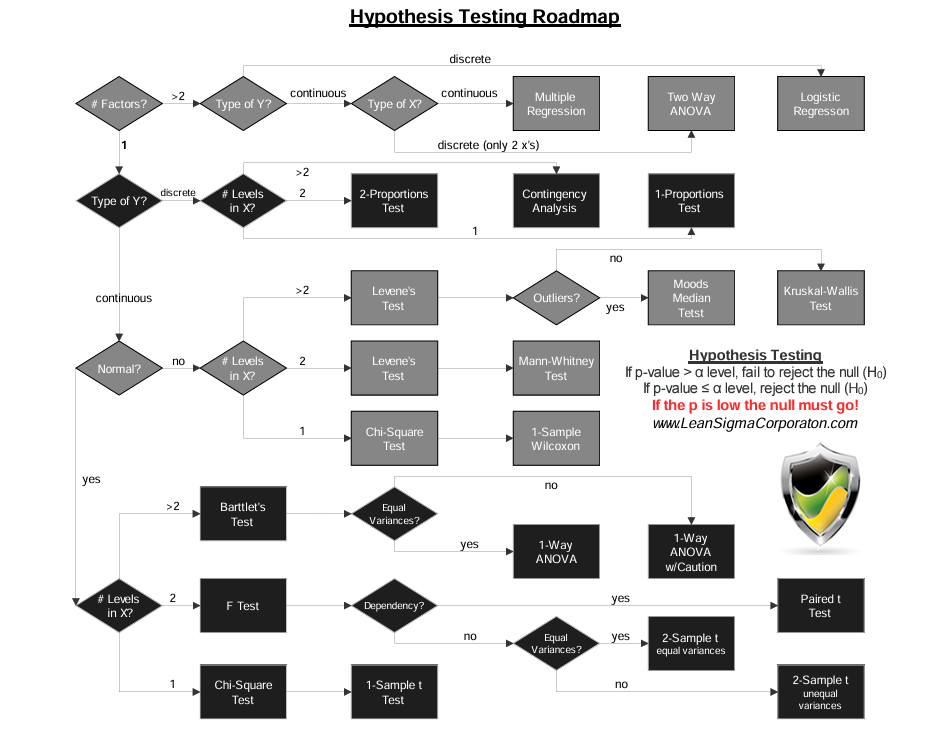
Hypothesis Tests Used in Six Sigma
The appropriate test depends on the problem being evaluated, the nature of the data, and the analytical objective of the project phase.
- One-Sample Tests
- Two-Sample Tests
- Paired Comparisons
- Analysis of Variance (ANOVA)
- Proportion Tests
- Non-Parametric Tests
Where Hypothesis Testing Fits in DMAIC
Hypothesis testing is most commonly applied during the Measure and Analyze phases of DMAIC, where data is used to validate suspected causes of variation and quantify performance differences.
- Validate suspected root causes
- Compare process performance before and after changes
- Confirm statistically significant improvements
- Support solution selection with evidence
Professional Use vs. Standalone Calculations
In professional Six Sigma practice, hypothesis testing is not performed in isolation. Tests are selected, executed, and interpreted within governed project structures, supported by data integrity standards and review processes.
Results are evaluated in context, alongside capability analysis, process knowledge, and improvement objectives, rather than treated as standalone statistical outputs.
Access to Hypothesis Testing Tools & Instruction
Instructional materials, statistical tools, datasets, and roadmaps related to hypothesis testing are provided through Six Sigma certification courses, programs, and authorized delivery models.
- Certification Courses
Structured learning programs covering statistical analysis and hypothesis testing aligned with certification exams. - Certification Exams
Professionally governed exams that assess statistical reasoning and application. - Authorized Training Partner (ATP) Program
For instructors and organizations delivering Six Sigma training under the Lean Sigma Corporation framework.
About Lean Sigma Corporation
Lean Sigma Corporation is an independent Six Sigma certification authority responsible for the development, administration, and governance of professional Six Sigma credentials. The organization defines certification frameworks, examination standards, and credentialing systems to evaluate and recognize Six Sigma competence across professional training environments.
Organizations and instructors delivering Six Sigma training in accordance with these recognized standards participate in Lean Sigma Corporation's Authorized Training Partner (ATP) Program.